The Lotus Eaters

February 6th, 2012 | Posted by Federico Campagna

“I was driven thence by foul winds for a space of nine days upon the sea, but on the tenth day we reached the land of the Lotus-eaters, who live on a food that comes from a kind of flower. Here we landed to take in fresh water, and our crews got their mid-day meal on the shore near the ships. When they had eaten and drunk I sent two of my company to see what manner of men the people of the place might be, and they had a third man under them. They started at once, and went about among the Lotus-Eaters, who did them no hurt, but gave them to eat of the lotus, which was so delicious that those who ate of it left off caring about home, and did not even want to go back and say what had happened to them, but were for staying and munching lotus with the Lotus-eaters without thinking further of their return; nevertheless, though they wept bitterly I forced them back to the ships and made them fast under the benches. Then I told the rest to go on board at once, lest any of them should taste of the lotus and leave off wanting to get home, so they took their places and smote the grey sea with their oars.”
Odyssey, IX


The sun stops half way through its descent towards the abyss. He wonders where it will go, as he moves his eyes away from the dark horizon. Beyond it, somewhere in the night, his comrades are still rowing through the uncharted sea. By now, if everything had gone according to plan, they should have approached the island… The island… Which island? It was home, long ago, but now he can’t even remember its name. Doulos slips a finger between his belt and the cloth he has around his waist. Carefully, he extracts one soft, fleshy petal. He puts it on his lower lip, and with his tongue he moves it inside his mouth, feeling its smooth surface turning thicker, then slowly dissolving. When he first tried the flowers, the overwhelming sweetness coated his tongue, and it was only out of courtesy for his kind hosts that he had kept on chewing. But now, so many flowers later, now that nothing distinguishes him form his hosts, now… Now… Oh, it’s gone. That thought is gone. No point in chasing it. And his comrades, yes. His comrades at home, wherever it is. But they are not at home, he knows it. Without proof, he knows it for sure.

It was that guy, their master. The man of many ways and no regrets. Like they turned the oars in their hands, he turned their lives in his. And enchanted them, even more than the penetrating juices of the petals of lotus. And now that the sun has started again its descent, in the coming darkness Doulos can see their mouths wide open, as the jaws of the unforgiving sea close on them. The monsters, on the shores, in the caves under water, and in the sky above the waves, they were nothing compared to him. The man who deceived Troy, the trickster who didn’t have to threaten his comrades to obey him, as they did so out of their misplaced love. Him… The king… Doulos squints in the agony of the day, and slowly walks back through the shrubbery. The rising wind swirls the sand around his worn-out sandals. In the distance, behind the olive trees, the lights of the village shine along a wide stretch of land. A few lazy crickets greet his stumbling steps toward his hut. A dog is sleeping in front of his door. Doulos kneels down in front of him and gently caresses his head. The dog growls sleepily, raises his head, licks Doulos’s fingers, sweetened by the lotus.

Behind his hut, beyond the lemon grove, and the stream, and the patches of maritime pines, a pile of enormous rocks cut the wind with their edges. He had hidden there, the day his comrades had come back to look for him. The villagers were still gathered around the fire, methodically chewing on their flowers, looking unimpressed at the foreigners’ frenzy. His comrades had searched the village, running from one hut to the other, shouting his name. The two who had accompanied him in the exploration tried to escape and were dragged back to the ships, in tears. Doulos was hiding behind the rocks, still short of breath. He could see the scene, from that distance, as one looks back at a fading dream just after awakening. He remained in hiding, almost motionless, throughout the night, until, at dawn, the new winds filled the sails and the wooden shells of the Greeks started moving away from the shore. As the ships moved further, Doulos tightened his grip on the rocks. That would have been the last time he would have seen his comrades, heard their voices, the sound of his native tongue… At last, as a final farewell, he heard Ulysses shouting, ‘Doulos, you traitor, you’ll be forgotten!’

Doulos stands up, walks towards the door, opens it. A woman is lying on a rug, chewing her portion of petals. She smiles at him, invites him to lie next to her. Doulos takes off his sandals, dusts off the sand on his feet. He goes to the table and pours two cups of water. He sits at her side, and passes her a cup. She ruffles his hair, gives him a petal. As the juice of the lotus envelops his mouth and teeth, memories get lighter. The dog comes in, and licks the water left in his cup. He looks at him wondering around he room, approaching the door and finally lying in front of it. Doulos reaches for another petal and slips it in his mouth. The woman, next to him, stretches her arm and takes his hand, rubs her fingers on his scars, on the long white marks that made him a soldier, on the hard layers of skin that made him a oarsman, on the painful joints that made him a subject of his master.

Doulos closes his eyes, and the sound of another dog, from another hut, faintly reaches him. There, someone else is reversed on the floor, near another half empty cup of water, far away from any memories. Oblivion. Even remembering oblivion is hard, once the lotus has enveloped you. The land around them, with its sand, the present darkness, the coming light, and darkness again, the distant ships, the wind singing through the rocks, the trees… Like fallen trees they all lie, protected from the sufferings of the world. Like corpses they live, so remote from life they could live forever. And forever forget, about the cares of the sailors, the soldiers, the kings and their ambitions, and their flocks of servants, reversed in the sand, lifeless, at the end of the battles, as the smoke of the sacrifices feeds the gods.

Years before, on the shores of Troy, memories of long-past wrongs possessed bodies much younger than the offenses they had been called to vindicate, and through their veins turned into the terrifying power of armed fists. The smile of the swords, at dawn, as the battlefield presented itself as the last day of the many, the memorable eve of the few. And the unbearable weight of the helmets, as burning as the sun, melting away the remnants of the fallen and the minds of the living. Once the dry plains in front of the burned gates of the city had drank more lives than they could stomach, the spectre of other plains, and other lands, came back to haunt the survivors. Home, as a curse. As a destiny, once again, calling them all to take up the challenge of death. And then, had they passed the swirls hidden between the waves, back again to the chains they used to call their own. The kings, always magnificent, raised they voices over the rowing crews. Home! they ordered. Triumphant commanders, on the deck of their ships, they showed no hesitation in taking the sea again, towards the beds in which their queens laid still, chained to their memory.

Sinking deep towards the boundless realm of the gods, the arrogance of those entitled to glory, the crowned few, pushed the ships away from the shore, back to the native fields and prisons. For Doulos, towards the mountainous pastures of Ithaca, where sheep and shepherds share the same thirst. Swapping the armor for the wooden stick, the sword for the whistle, the obedience in the face of death for that of an entire life. Back, back again. Like a winter that follows an unforgiving summer. Between the sea and the shore, craving a corner to sleep on the crowded deck, on the fields of sheep and tributes, hiding from the wrath of the gods as from that of the king, his face in the sand, his hands, older by the day, gripping on the same myths. Lost in an oblivion in which he only would have remained awake to himself, to his forgettableness.

Until, they took shelter in the land of the lotus eaters, after many days of tempest. The woman starts singing softly, in a language he still does not understand. But is there anyone who understand it? People don’t speak, in the land of oblivion, as they don’t remember their own names, and their debts fade into nothing, as the dogs that move from hut to hut, without fidelity. Is this his woman? He cannot say, and in her dark hair there is no place for the mark of anything but of his fingers, caressing her, rhythmically moving along the riffs of her skull. Is this life at all? He places another petal between his lips and presses in with his teeth. The juice trickles, underneath his tongue, between the molars. Memories get lighter. But he has already thought that. But it doesn’t matter. Thoughts die and are reborn, in a swirl of seasons passing so rapidly, as if the countless days that make the world were comprised in those very moments. And then they die, each and every instant, leaving him motionless, perfectly clear, polished like the bark of an old tree. And behind him, beyond the lemon grove, and the stream, and the patches of maritime pines, a pile of enormous rocks are still cutting the wind with their edges. He has been there, one day, many years ago. He had gone there to look at the sky, and the sea, and had fallen asleep. And he had a dream, and had awakened. And again.
And again.
And again.
Until all the seasons would have run out.

TwitterPingDeliciousEmailInstapaperPrintFriendlyFacebook

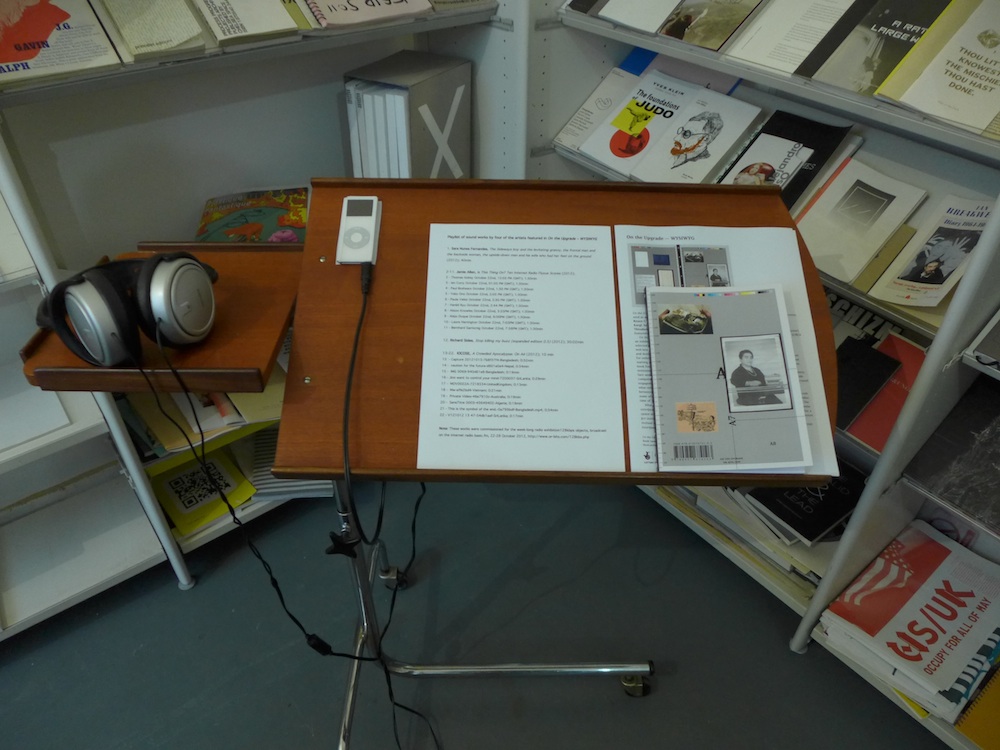
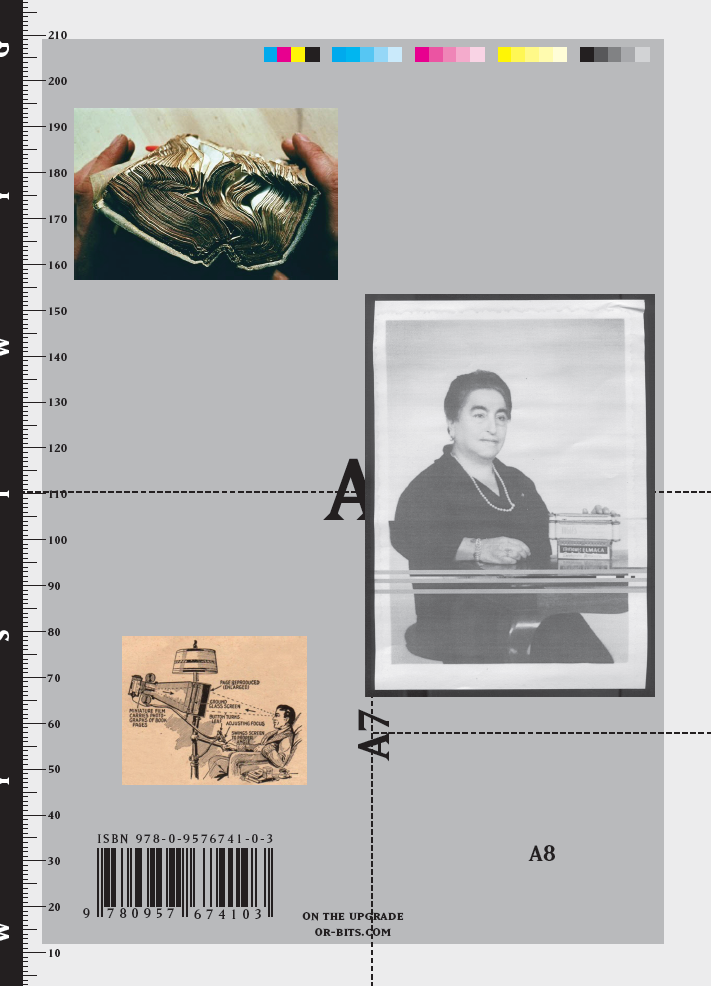
‘On the upgrade’ at the WildBookMarket (WBM), Rotterdam || 10-12 February 2012

February 6th, 2012 | Posted by admin

‘On the upgrade’ will be on display and available for purchase at the WildBookMarket (WBM) 2012 held at the artist run space Het Wilde Weten, in Rotterdam, from 10 to 12 February 2012.

Het Wilde Weten invited artists, and small, independent publishers, to present their publications at the 3rth edition of the WildBookMarket (WBM).
At the WBM artists, independent publishers, an art academy, and graphic design studios will present their most recent, special, exciting and unique art books and zines.

Opening night: 10 February 2012, 19.00 – 23.00

More info on HWW website.

Where:

Het Wilde Weten
Robert Fruinstraat 35
3021 XB Rotterdam
The Netherlands


TwitterPingDeliciousEmailInstapaperPrintFriendlyFacebook

Truth or Lies (Part 3)

January 30th, 2012 | Posted by Jennifer Steele

The problems with knowledge and information in an online era

We are all familiar with the optimistic ideologies of cyber-libertarianism.  This new online space reduces hierarchies, and creates a freer, more equal world – eradicating geographical constraints.  The internet provides limitless amounts of information, increasing our ‘knowledge’.  Similarly, Neo-Luddites in the opposed corner, clings onto slower, more concrete methods of communication and knowledge sourcing – revering the printed book and face to face discussion.

However, there is no denying the time efficient benefits of immediate access to information regarding any query from a practical to a philosophical level.

Whilst in residence in China, my possibility for this common place dipping in and out of the internet for advice and knowledge was severely limited.  Not only social networking sites, but any page that contained text or visuals deemed inappropriate, was shut off by a government sensor.  Over time, I stopped trying certain routes or pathways for information, as I was repeatedly being denied access.  While I adjusted to the cultural changes in life on a physical level with social behaviour in my studios and within the local streets, I also altered my approach to my behaviour online.

Without looking back too nostalgically, my life whilst in Chongqing felt more ordered, streamlined and focused on the daily tasks at hand, and long term goals.  I was not regularly side-lined by twitter and chatter on social networking sites, and I did not spend time looking through personal photographs of events I had never been and knew little of the people involved.  As research based websites for my project were restricted, I focused on conversations, observation and texts that I had brought with me or been given.  I did not feel ‘the guilt’, that outside of my own physical life, I was not constantly checking, looking and engaging with what is happening online, feeling somewhere that perhaps I am missing out on new developments.  I just could not access it – so in many ways I was grateful for what the governmental control of the PRC provided for me through censorship.

Not all routes lead to home, spraypaint in HuangJePing, 2011

The internet undoubtedly has radicalised opportunities, movement, information, knowledge, time efficiency and communication.  But this parallel life online is often tiring, keeping up with constant engagement with ever pouring knowledge and information.  Often those I am physically with in a space, I do not focus upon them and vice versa.  Perhaps there is a requirement for judgement of the value of information online – which may be identified through alignment with our own personal set of values and interests.

However, in many instances places online link in with our everyday life so closely, it is hard for us to eradicate ourselves from them.  For example, friends send invitations to birthday parties within Facebook, meetings are agreed through email, job opportunities exposed through Twitter.  When I emailed artist Ellie Harrison in January 2012, I received an automatic response that informed me that as an experiment she would not use her email for the whole month.  This is a test which will surely provide interesting results.

Social networking sites provide a large amount of personal honesty and ‘truths’.  Confessions of the minutia of daily lives within programmes such as Twitter intrigue us in a similar format as would a reality show, or a Sophie Calle artwork.  Although I engage in Twitter, I am concerned and a little perturbed by the public’s willingness to communicate so much about their whereabouts, relationships and duties. For me, there is information that I simply want to keep to myself and those I am close to.


This is where we meet, Spraypaint in 102 Studios, Chongqing, 2011

Slavoj Žižek addresses this concern over ‘privacy disappearing in public’ in his essay, ‘Good Manners in the Age of Wikileaks’.  Following a narrative discussing respect for a person’s physical space being invaded, he alludes to -

“Appearance, the public face, is never a simple hypocrisy. E.L. Doctorow once remarked that appearances are all we have, so we should treat them with great care. We are often told that privacy is disappearing, that the most intimate secrets are open to public probing. But the reality is the opposite: what is effectively disappearing is public space, with its attendant dignity.”

I make decisions where I will go and what I will do on a daily basis.  I selectively choose what books I will withdraw from the library, knowing that there is a never ending supply of text, image and ‘knowledge’ awaiting me for when I return the next time.

Yet my decision making online is less confident.  I am swayed, brought in, tempted through boundaries by speed.  I need to become more assertive, and remember when to respectfully say ‘no’.  Or do I?


TwitterPingDeliciousEmailInstapaperPrintFriendlyFacebook

January 17th, 2012 | Posted by Nathan Witt

The bookshelf and the spell check, illiteracy in Microsoft Word (2005)


Dictionary of Proverbs/ Baudrillard’s Ecstasy of Communication/ Dictionary of Superstition/ Deleuze and Guattari: 1000 Plateaus/ The Two Sources of Morality and Religion/ The Architectural Uncanny/ Being and Time/ Situationist International/ Anti-Oedipus/ The Social Contract/ The Nose/ Lights Out for the Territory/ Of Grammatology/ Clytemnestra/ Oedipus/ Electra/ Alcestis/ Medea/ ETA Hoffmann/ Orestes/ Lysistrata/ The Eumenides/ The Theban Plays/ Baudelaire’s The Generous Gambler/ The Napoleon of Notting Hill/ Melmoth the Wanderer/ Barthes’ The Eiffel Tower/ Rousseau’s Confessions/ Steppenwolfe/ Little Arthur Rimbaud and Paul Verlaine/ Will to Power/ Grossmith’s Diary of a Nobody/ What is Literature?/ Blanchot/ The Arcades Project/ The Stones of Venice/ Kristeva/ Nausea/ Juvenal’s Satires/ Anais Nin/ The Anatomy of Melancholia/ Beyond Good and Evil/ Suite Ventienne/ The Prince/ Henry Miller/ The Return of the Real/ The Robert Crumb Handbook/ Madness and Civilization/ World View/ Fathers and Sons/ The Russian Criminal Tattoo Encyclopaedia/ Mark Twain/ Ovid/ Aesop/ Ray Johnson’s a Laugh/ The Man who was Thursday/ Doge and Dogaressa/ Richard Prince/ Sigmar Polke/ Priories and Abbeys of England/ Romanesque/ Ruscha’s Leave Any Information at the Signal/ Modern Man in Search of a Soul/ Why Do Women Write More Letters Than They Send?/ Barthes’ A Lovers Discourse/ Straw Dogs/ Herodotus The Histories/ The R Crumb Handbook/ Francis Wheen’s Karl Marx/ Manners and Morals/ The Moment of Self Portraiture in German Renaissance Art/ John Julius Norwich’s A History of Venice/ Venice and the Renaissance/ Piranesi/ Gustave Dore/ Debord’s The Theory of the Derive/ The Parisien Prowler/ Post-Humous Papers of a Living Author/ The Species of Spaces/ Down and Out in Paris and London/ Lord Jim/ Madness and Civilization/ The Object Stares Back/ Ray Monk’s Bertrand Russell Vol 1/ Ray Monk’s Bertrand Russell The Ghost of Madness 1921-70/ CT Onion’s Oxford Dictionary of Etymology/ The Compact Oxford Dictionary/ The Oxford Dictionary of Art/ The Hutton Report/ Chris Burden’s When Robots Rule and The Two Minute Airplane Factory/ Jamie Shovlin on Naomi Jellish/ Jeff Wall/ Raymond Pettibon/ Bruce Nauman/ Mike Kelley’s Catholic Tastes/ Wells Cathedral/ Caravaggio/ From Constable to Delacroix/ Moliere Three Plays/ Candide/ Mythologies/ A Lovers Discourse/ Life A Users Manual/ The Man Without Qualities/ Zazie on the Metro/ L’exercises du Style/ The Lives of the Artists/ Myth of Sisyphus/ The System of Dr Tarr and Professor Fether/ Dave Hickey/ Augustine’s Confessions/ The Critique of Pure Reason/ Erasmus’ In the Praise of Folly/ Helene Cixous/ The Aenid/ Lyotard’s The Post Modern Condition/ Lyotard’s Confessions/ Poetics of Space/ Aristophanes’ Birds, his Wasps, his Frogs and his Clouds/ The Secret Heresy of Hieronymous Bosch/ Prometheus Bound/ Gogol/ The Prisoner of Venice/ Rabelais/ Camus’ Fall, his Plague, his Rebel and his Outsider/ Faust/ Faust/ Faust/ Arrian’s Campaigns of Alexander/ Writing and Difference/ Blanchot’s Friendship/ Derrida’s On Friendship/ Betty Radice/ Michael Wood/ The Confidence Man/ Geoffrey Chaucer/ Being and Nothingness/ Bataille/ Johannes Itten/ Catholic Tastes/ Breakdown/ Plato/ John Ruskin’s Sesames and Lilies/ Harrison and Wood/ Revenge of the Crystal/ PD Ouspensky/ CG Gurdjieff/ Lucretius’ De Rerum Natura/ JK Huysmans’ Against Nature/ Paradisio/ Purgatorio/ Inferno


TwitterPingDeliciousEmailInstapaperPrintFriendlyFacebook

Truth and Lies (Part 2)

December 14th, 2011 | Posted by Jennifer Steele

Certainty and fallacy….

What is certain, is that within People’s Republic of China, digital space is governed very similarly to physical space, with equivalent extent of constraints and laws placed and enforced in ‘real space’. In one sense, this approach is progressive as the PRC treat the unquantifiable notion of ‘digital space’ – which we often disregard in the West as not even ‘space’, or an ‘other space’, such as within Foucault’s definition of heterotopia[1].  This ‘other’ space, has become the space within our phone, computer, television and Kindle that we ‘occupy’ more and more – should we not abide the same courtesies and regulations as in everyday walled space?

As outlined as the PRC’s governmental white paper, which can be read on the PRC State Council’s web-site [2], the government communicates that it seeks to promote free speech, movement and exchange online. However, the situation online is very much one of close control and inspection as outlined in my last post. When internet users in the PRC attempt to enter Western social networking or blogging sites, or in fact any sites deemed with inappropriate content by the government, the user is re-directed to another ‘safe’ site, or a notice comes up advising the ‘netizen’ that the server has timed out. Similarly internal social networking sites in the PRC, are closely regulated by government officials.  What is certain and commonplace is that you will be regularly told such a fallacy about why you cannot enter a digital space.

Prior to my six week residency in China, I had researched into how historical architecture and town planning from the Ming Dynasty functioned on this system on this very system of hierarchical control. Within the PRC, Ming Dynasty town layouts from the Empire of the Great Ming (from 1368 to 1644) form the basis of many ancient cities and towns across China. The structure of the walled cities all follow a pattern similar to the Forbidden City in Beijing, which consist of an Outer City, Inner City, Imperial City and Forbidden City. Persons were carefully classed and kept strictly to movement within certain areas of the overall city, with only the most important people at the top of the social hierarchy being able to access the centre of the city municipality.  This walled formation still exists at many of the main cities and towns, although gateways and rules on physical movement are generally no longer adhered to.


In Sichuan Province, I spent time visiting the structures of the walled towns of CiQiKou and Huangdong Complex. The original structures of gateways still remain between separate areas of winding walkways in inner, outer and central sections, although people can move freely between physical spaces.


Similarly, I also visited the walled city of Xian, which was built in the Chang’an period prior to the Ming Dynasty, with the centre of the city formed around a walled rectangular configuration. Xian, in Shaanxi Province follows the structure of a series of external and internal walls, and historically entrances and exits were guarded with serious consequences. In many situations the walled structures, arenow glorified as successful tourist attractions, and are one of the few examples of historical architecture amongst the rapidly growing high rise skyscrapers.


In one sense, the situation of control over individual’s movement in the aforementioned walled historical cities would be deemed as truthful, as circumstances are made clear to all inhabitants of any cause and effect of movement, as well as awareness of social positioning. The current situation of online control by the PRC appears as telling a recurring fallacy to its occupants when attempting to enter certain spaces online. However, all PRC nationals understand that the information given by the government is a lie; thus permanently reinforcing the dissolved meaning of any information labelled as a ‘truth’ or ‘fallacy’.

An original intention in my enquiry, was to highlight that within such an on-going situation of historical governmental control – history was clearly repeating itself from the physical to the digital. However, from the physical walls and barriers, to the current ‘re-direction’ and ‘network timeout’, it is evident that, as Mark Twain outlines, ‘History does not repeat itself, but it does rhyme’[3]. There are patterns, and comparisons, but differing frameworks and social issues. But how does the control online change the experience of physical space and cities within the PRC?  How does this control of movement digitally enforce or dissipate knowledge in an online era?  And is there hope for a democratic or libertarian approach to digital space within the PRC, or is this idealised notion of the internet outmoded and unrealistic anyway?


[1] Michel Foucault. Of Other Spaces (1967), Heterotopias. http://foucault.info/documents/heteroTopia/foucault.heteroTopia.en.html.

[2]Information Office of the State Council of the People’s Republic of China. June 8,2010, Beijing http://www.china.org.cn/government/whitepaper/node_7093508.htm

[3] Mark Twain, The Jumping Frog: In English, Then in French, and Then Clawed Back into a Civilized Language Once More by Patient, Unremunerated Toil, illustrated by F. Strothman, New York and London, Harper & Brothers, Publishers, MCMIII,p. 64.

TwitterPingDeliciousEmailInstapaperPrintFriendlyFacebook